

Texas real estate agents: Avoid these contract errors, and you’ll be ahead of 90% of your colleagues!
1. Missing or Incorrect Details in the Property Description
In Paragraph 2A, where you’re defining what’s being sold, there are some innocuous-looking little blanks for you to fill in lot number, block number, etc. More folks than you might imagine make some small error in filling out the legal description. Needless to say, they live to regret this.

What’s the big deal, you ask?
The big deal is that if you want to write a contract that can actually be enforced, you have to be sure the legal description is spot on. Input the wrong lot number or parcel number, or describe the property boundaries wrong, and your contract may not be enforceable.
This may seem obvious, but be sure the information you fill in belongs to the property you’re actually selling. Double check lot and block numbers. Triple check property descriptions that sound vague and outdated. If the boundary is described as “along the wet-weather stream until you get to the old red maple,” be very wary. And if a little voice in your head tells you that the legal description feels a little too hazy, get a new survey ASAP.
Needless to say, even small mistakes in the legal description of the property can cause everyone involved very big headaches. If the mistake goes unnoticed, you may need a correction deed or even a quiet title lawsuit to resolve the issue. Trust me: You don’t want this. You want to get the contract right the first time around.
Review the heck out of the contract and the deed before closing your transaction. The extra effort is worth it.
2. Not Making Sure Earnest Money Is Paid on Time
If a buyer doesn’t pay the earnest money within the proper time frame, this can be a breach of contract, and the seller has the right to terminate.
Paragraph 5 is pretty clear on when the earnest money is due:
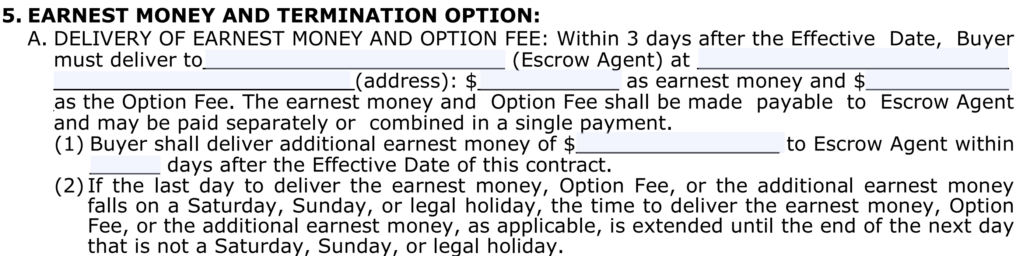
I think this is simple enough that you probably don’t need a plain English translation. Still, agents and buyers bungle this one. I get it: Our human brains are flawed, and we forget things — especially in the mad dash to buy a house, with so many tasks to perform and a confusing parade of deadlines.
It’s our job as agents to cut through the confusion and help our clients meet all these deadlines. But sometimes, I think the agents themselves are misinterpreting the terms of the contract. And of course, sometimes a miscommunication between agent and buyer can lead to a late payment.
Don’t let this happen. You don’t want to see your client lose out on a contract, forfeit their earnest money, or end up in a legal fight. Just set a nice little alarm on your calendar and email your client to remind them the money is due.

3. Failing to Make Sure Utilities Are Turned On for Inspections
You know this: The seller has to let buyers and their agents have reasonable access to the property to do inspections and walkthroughs, and the utilities must be ON during the contract period.
It’s all right there in Paragraph 7A:

Obviously, the buyer can’t do a proper inspection or appraisal if the water and electricity are off, so the seller needs to make sure these are on and working. Not to mention the danger of damage to the home due to frozen pipes in winter or mold in summer — if you leave the HVAC off for weeks on end. You don’t want this to happen on your watch as a seller’s agent.
Want to switch it all off after you close? Go for it. But please, keep the lights on until then.
For more great information on the Texas 1-4 Family Contract, explained in plain English, get Candy Cooke’s self-paced course at Agent eLearning, Texas 1-4 Family Contract Updates.